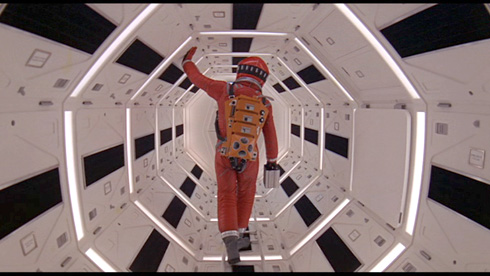
Hejduk. Vladivostok, 1989

Turrell. Afrum-Proto, 1996

Eliasson. Mirror door (visitor), 2008
The following is the 14th chapter of a terrific story called Crippled Detectives by Lee Tandy Schwartzman (age 7, Seattle, Washington, in 1978). The story first came to my attention a few years ago and every now and then I find myself thinking about it, usually triggered by the oddest things. I still haven't read it in its entirety, but it definitely remains a place of constant wonder for me.
The whole novel can be found here at the website of its publisher, Stone Soup.
Chapter Fourteen
After Today
Lee: I feel like singing a song.
Sylvia: O.K., okey dokey.
And this is how the song goes:
After today the world’s gonna spin incorrectAfter the song Sylvia began to cry, whispering, “Lee, Ben’s gonna die tomorrow, oh Ben’s dying, Lee, tomorrow he’ll die.” Sylvia lay her head on Lee’s apron. “And,” cried Sylvia, “I’m gonna cry forever. Our parents went on a airplane, the airplane crashed, and it has not been found.” Lee cried too. Suddenly Sylvia stopped crying. “Lee, it means we have to take care of the youngsters, even Ben if he is still alive. It means we’re women, we have to fight the villains and take care of our family at the same time. We’re four or five alone.” But the day after Ben died and the girls wept upon his grave, but only the elders held back their tears, but black clouds came and they ran for cover for it would rain.
-from Crippled Detectives by Lee Tandy Schwartzman

A couple of paragraphs from this article, Enlightenment Therapy, by Chip Brown:
" What darkness is to psychoanalysis, light is to Zen. In pursuit of mystic illumination, “the vast ocean of dazzling light,” Zen is cheerfully unconcerned with the manufacture and distribution of personal meaning. It tends to discount the authority of the unconscious and to ignore the significance of dreams. Students are discouraged from delving into the content of emotions. Where psychoanalysis is keen to unpack a patient’s past — especially those aspects of the past that distort perception in the present — Zen dwells on awareness in the present. This! Here! Now! Zen masters have been known to whack students with a stick.
It’s no surprise that such an unlikely pair got off to a rocky start. For decades the feeling of being “one” with the universe, prized in Zen as an attribute of enlightenment, was belittled by many psychoanalysts as an “infantile regression.” By the same token, the injunction “know thyself,” the ultimate chocolate-cherry in the candy box of Western wisdom, was brushed off by Zen adherents as a delusion. What’s to know about a conceit that has no fixed reality and more often than not is an impediment to experiencing Buddha nature? The self, as one Rinzai teacher put it bluntly, “is a malignant growth which is to be surgically removed.” "